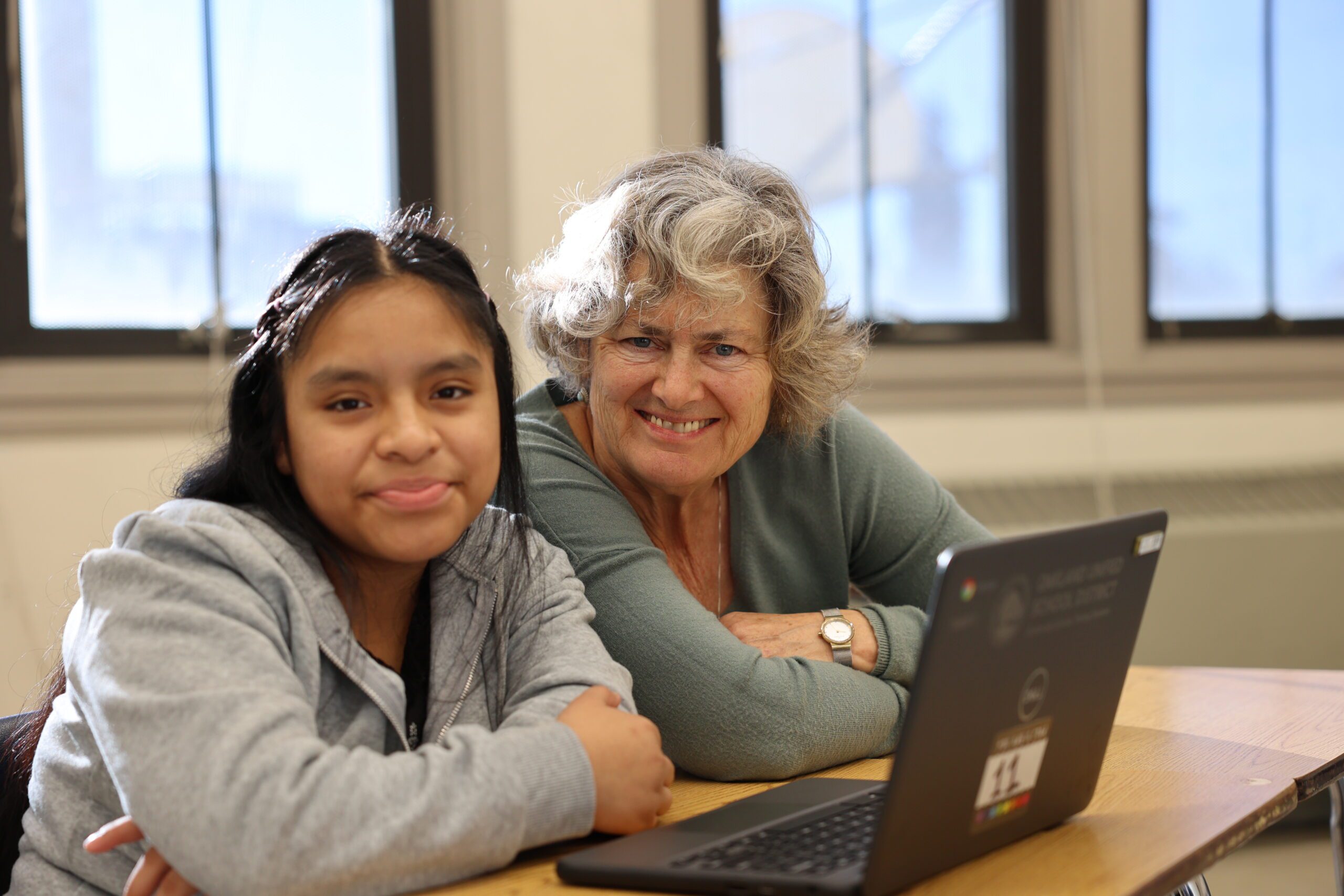


Cigan Valentine is a senior at Berkeley High School who attended King Middle School, where she had her first encounter with a writer coach. Since then, she has embraced her love of writing in numerous ways. Cigan is a co-copy chief of Berkeley High’s famed Jacket newspaper, the Editor in Chief of one of the school’s literary magazines, The Foundress, and an avid reader. Cigan hopes to study English and Creative Writing in college, along with a list of other subjects too long to name.
Years before I myself was a middle school student, my mom came home chattering about her new volunteer position. She proudly announced her future job as a writer coach, which would allow her to pursue her secondary passion of teaching. This pronouncement was met with little response from me and my sister. We eyed each other suspiciously. What was she up to? I was skeptical, and frankly couldn’t care less. Writing tutoring? Who needed writing tutoring? To me, writing didn’t matter. It was only something we were made to do in school. It was the sorry equivalent of homework, and I associated with the task the annually dreaded district assessments. My future held no room for such a novelty. Writing was something that was to be easily avoided, at all costs. Writing, I declared silently, was certainly not for me, or so I thought.
Fast forward to my eighth-grade year, and that moment came flashing back to me. As a line of what looked like my classmates’ parents, aunts, uncles, and grandparents came filing into the room, I looked up, annoyed at the disturbance. Names were communicated, then forgotten. I stubbornly looked down at my own work, in which I could see no flaws. Fifteen minutes passed, then a half hour. I thought I had dodged a bullet. And then, just as it seemed that time was slipping by and I with it, my name was called. My writer coach, a tall, friendly man whose name I instantly forgot, walked me to the library. In silence, he got to work reading my piece, a story that was meant to communicate an important historical event.
I sensed that he was done with my story before he looked back up at me. We were silent for a moment, as the buzz of chatter from other duos floated over us. Finally, he spoke.
He didn’t mind the wild fabrications, or the lack of historical accuracy. No, those were the workings of a creative mind, the creative mind of an eighth grader. What mattered was clarity. Structure. A plot. A story worth reading.
“What’s the point?” he asked me. I paused. The pause grew into a silence. What was the point? Why was I writing this, aside from the historical fiction assignment? I couldn’t answer. So we backtracked. We went back to the start, the idea from which the story grew. Why did I choose a young girl, instead of, say, a man? What does she feel? How can the reader feel that? And step by step, minute by minute, we rewove the story, added meaning here where there wasn’t any before, fixed punctuation, spoke some more. He gave me space to write, but when commentary was necessary, he was there to help. And then, the twenty minutes were done. I returned to class. And at the end of the week, a fleeting, sweet surprise: I got a fantastic grade on my story.
It took me many years, years after my mother’s exclamation, and my brief yet meaningful encounters with my own writer coach, for me to finally grasp why my mother was so excited about being a part of the writer coach organization. Out of the blue, it seemed, writing did matter. It wasn’t then and there, and it was far from immediate, but as my own life began to take shape around words and their meanings, I realized that the importance of writing stems from its ability to make its wielders heard.
Now, with Berkeley sadly having one of the widest achievement gaps in the country, writing literacy is more important than ever. Sure, persuasive essays are widely overused, and frankly, quite tedious, but they teach us something essential: how to express your beliefs, how to make yourself heard. Being able to write an essay means that you can also write an email, or a pamphlet, or a petition, or whatever it is you need to write to make yourself heard in a world where an increasing number of people are going silent. Everyone has a story within them, but not all have the encouragement to tell it.